I don’t remember the first time I saw the mosaic, Confluence of Civilizations by Juan O’Gorman that sits above the San Antonio Riverwalk. In 1997, my family and I had come to San Antonio, Texas to visit my brother who had just graduated from the United States Air Force boot camp. Like many of the families, we ventured down to one of San Antonio’s biggest tourists spots, the Riverwalk. Once on the Riverwalk we loaded up onto a riverboat tour. That is all I remember about that visit to downtown San Antonio. At fifteen years old, my mind was preoccupied with other things, like how my hair looked and how hot it was. I did not take the time to appreciate the architecture and art that adorned the Riverwalk. I was not in a mindset to absorb the history that surrounded me. It was not until 2012, when I came back to San Antonio to live that I would see the mosaic again and appreciate what the work represents and what it took to make it.
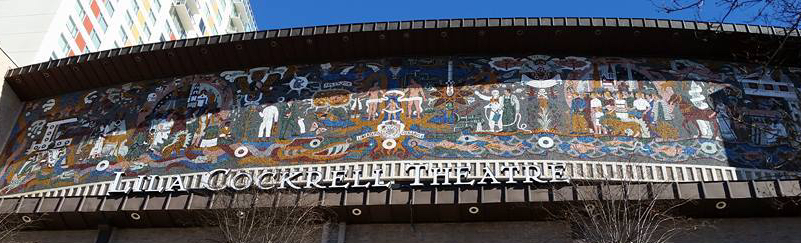
The Confluence of Civilizations is located on the Western entrance of the Henry B. Gonzalez Convention Center. Just above the sign for the Lila Cockrell Theater. Patsy Steves commissioned the piece. She had commissioned the piece on behalf of her husband, Marshall T. Steves, president of the 1968 San Antonio HemisFair committee. Patsy convinced an avid collector of Mexican Artwork, Flora Cameron Chrichton to fund the project (Monroe, 2016). The mosaic measures roughly 110 X 22 feet. The design contains 1.2 million natural stones and pieces of glass (Digital Public Library of America, 2017). The artist made the mosaic at his studio in Mexico City. It was then brought to San Antonio in 540 separate panels. The total weight of the mosaic is around Five tons (Cooke, 2017).
Juan O’Gorman made the Confluence of Civilizations to represent the joining of cultures to create a new world. O’Gorman himself was a representative of cultures coming together. He was the son of a Mexican mother and Irish Father (Monroe, 2016). He grew up in Mexico and became an architect, muralist, and professor. O’Gorman was known early in his career as an architect of functionalist design. In the middle of the 1930’s he would turn away from functionalist architecture and focus on painting. In the 1950’s he would return to architecture with a focus on a more organic approach (The Editors of Encyclopedia Britannica, 2007). During his time as a professor at the University of Texas Austin, Juan O’Gorman was approached about making the mosaic for the HemisFair (Cooke, 2017).
I have had the pleasure of seeing Confluences of Civilizations more than a dozen times now. The more I see the piece, the more I appreciate it. The size of the work allows for a lot of detail and with each visit, I see something new. In the middle is Adam and Eve. To the left is the representation of Mesoamerica and to the right is a rocket ship and astronaut. The mosaic symbolizes where we came from, where we are, and where we are going. I appreciate the meaning of the piece, especially with where our country is today. We are one people with one earth.
References
Cooke, C. N. (2017, February 24). Juan O’Gorman. Retrieved from Trinity University Press: http://tupress.org/books/juan-o-gorman
Digital Public Library of America. (2017, February 24). O’Gorman Mural- Theater of performing arts- Convention Center. Retrieved from Digital Public Library of America:https://dp.la/item/a439acadc699c9e7a15ad3a401c73a4b
Monroe, N. C. (2016, 12 8). Confluence of Civilizations Awakens ‘New’ San Antonio to a Signature Work of Art. Retrieved from Rivard Report:https://therivardreport.com/confluence-of-civilizations-awakens-new-san-antonio-to-a-signature-work-of-art/
The Editors of Encyclopedia Britannica. (2007, 10 9). Encyclopedia Britannica. Retrieved from Juan O’Gorman: https://www.britannica.com/biography/Juan-OGorman

 Nicole Hoffmann